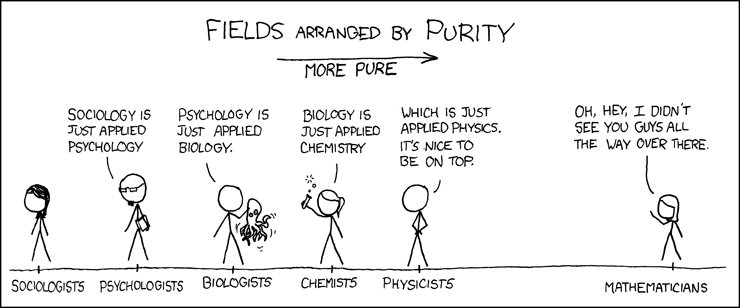
So, so, we're starting a maths club to help all suffering from any maths related traums/injuries!
Please feel free to post any maths related question here, and I'll try my best to answer them!
Wood chuck only chucks one wood if a wood chuck could chuck wood.
The mistake in this proof is step number 5.
There you divide by (x-y) but x=y, therefore (x-y)=0
Dividing by zero. Tut tut tut
Quote:
Dividing by zero in the first? Not even sure how the second one is a thing
The second one is a thing because he established that 1+1 = 1
Extending on that:
If we assume that 1+1=1, then 2=1, and therefore (by subtracting 1 from each side) 1=0.
Now:
Barack Obama has no leafy green top, but 1=0, therefore he has 1 leafy green top.
The wavelength of a photon emitted from Obama is (x)nm.
Because 1=0 we can say that
1x=0x
so
1x=0
Adding 585 to both sides
1x+585=585
But since 1=0,
We can show that
585=0 by multiplying both sides by 585.
Therefore:
x=585.
And as such, the photons that radiate from Barack Obama have a wavelength of 585nm, and he therefore appears bright orange.
Obama's waist is ycm wide, and similarly to above, we can show that y=0cm.
Therefore, Obama tapers to a point.
Now that we have shown that he has a leafy green top, is bright orange and that he tapers to a point, I can conclude that Barack Obama is a carrot.
___________________________________
Monobattle mentality: "Oh? He's got Brood Lords? Guess I'd better make more banelings."
Last edited by AxS.Sorathez; Wed, 9th-Jan-2013 at 9:38 PM.
I now realize how mathemathically less inclined I am compared to the rest of you guys now after reading through this thread.
I don't even get half the terms that you are using :P
___________________________________
Formerly known as neozxa
Instead of complaining about balance, try, try again.
Earlygame ZvZ is basically a knifefight with suicide bombers.
Hey I got a trigonometry question for you guys:
Use mathematical induction to prove that for any positive integer n,
sinx+sin3x+...+sin(2n-1)x= (1-cos2nx)/2sinx
where sinx =/= 0
Hey I got a trigonometry question for you guys:
Use mathematical induction to prove that for any positive integer n,
sin x+sin 3x+...+sin(2n-1)x= (1-cos2nx)/2sin x
where sin x =/= 0
I'll use the indentity (1) (sin x)^2= (1-cos 2x)/2
because (sin nx)^2/(sin x) is easier to work with.
and also use
(2) (sin A sin B=1/2(cos(A-B)-cos(A+B))
Set n=1
lhs=sinx
rhs=(sin x)^2/sin x
=sin x
=lhs
true for n=1
Assume n=k
sin x+ sin 3x+...+sin(2k-1)x=(sin kx)^2/(sin x)
For n=k+1
lhs= ((sin kx)^2)/sin x+sin(2k+1)x
=(((sin kx)^2)+sin(2k+1)x sin x)/sin x
=(((sin kx)^2)+1/2(cos(x-2kx-x)-cos(2kx+2x))/sin x (2)
=(((sin kx)^2)+1/2(cos(-2kx)-cos(2kx+2x))/sin x
=(((sin kx)^2)+1/2(cos(2kx)-cos(2kx+2x))/sin x
=((((sin kx)^2)+1/2(1-2(sin kx)^2-(1-2(sinkx+x))^2))/sin x
=((((sin kx)^2)+1/2(2(sin kx+x))^2-2(sin kx)^2))/sin x
=((sin kx)^2+(sin kx+x))^2-(sin kx)^2)/sin x
=(sin(k+1)x)/sin x
=rhs
I'll use the indentity (1) (sin x)^2= (1-cos 2x)/2
because (sin nx)^2/(sin x) is easier to work with.
and also use
(2) (sin A sin B=1/2(cos(A-B)-cos(A+B))
Set n=1
lhs=sinx
rhs=(sin x)^2/sin x
=sin x
=lhs
true for n=1
Assume n=k
sin x+ sin 3x+...+sin(2k-1)x=(sin kx)^2/(sin x)
For n=k+1
lhs= ((sin kx)^2)/sin x+sin(2k+1)x
=(((sin kx)^2)+sin(2k+1)x sin x)/sin x
=(((sin kx)^2)+1/2(cos(x-2kx-x)-cos(2kx+2x))/sin x (2)
=(((sin kx)^2)+1/2(cos(-2kx)-cos(2kx+2x))/sin x
=(((sin kx)^2)+1/2(cos(2kx)-cos(2kx+2x))/sin x
=((((sin kx)^2)+1/2(1-2(sin kx)^2-(1-2(sinkx+x))^2))/sin x
=((((sin kx)^2)+1/2(2(sin kx+x))^2-2(sin kx)^2))/sin x
=((sin kx)^2+(sin kx+x))^2-(sin kx)^2)/sin x
=(sin(k+1)x)/sin x
=rhs
Therefore, true for all n.
I had quite the love/hate relationship with mathematical induction in High School...
___________________________________
Monobattle mentality: "Oh? He's got Brood Lords? Guess I'd better make more banelings."
"and we'll invest more on Bots, as our first Trial bot, the 'NemBotElie' was a huge success, organising tournaments and being part of the Council of mGG. But there are a few bugs in which the bot cannot go past the skill level of a Platinum Protoss." - PaRAnorMaL
___________________________________
Formerly known as neozxa
Instead of complaining about balance, try, try again.
Earlygame ZvZ is basically a knifefight with suicide bombers.
how stuff is added, at least thats how I understand it, multiplicativity (is that even a word?!) would be how stuff is multiplied, or the axioms that multiplication is based on.
I don't think you can derive commutativity from only closure, associativity, identity and inverses.
For example consider the general linear group consisting of nxn matrices with nonzero determinant.
- It is closed (multiplying two matrices with nonzero determinant results in a matrix with nonzero determinant)
- It is associative (matrix multiplication is associative)
- It has an identity
- It has inverses
And yet any two matrices in the general linear group need not commute.
___________________________________
mGGTitan [NA ] (HotS)
Previously known as mGGTitan
"We are terran. We never surrender. We always fight 'till the end." - Empire Kas
I don't think you can derive commutativity from only closure, associativity, identity and inverses.
For example consider the general linear group consisting of nxn matrices with nonzero determinant.
- It is closed (multiplying two matrices with nonzero determinant results in a matrix with nonzero determinant)
- It is associative (matrix multiplication is associative)
- It has an identity
- It has inverses
And yet any two matrices in the general linear group need not commute.
Matrix multiplication is not commutative but addition is.
It is definitely possible to derive from the 4 stated axioms.
___________________________________ from New Zealand, living in Canada
twitch.tv/muex
twitter.com/mGGMueX
Matrix multiplication is not commutative but addition is.
This is exactly the point - both (GL,*) and (R,+) are groups (i.e. satisfy the four given axioms) but (GL,*) is not commutative - so the group axioms are not enough to prove that (R,+) is commutative, you need some extra fact.
As for deriving commutativity from the peano axioms, that's actually fairly tricky, but it can be done. The trick is to prove associativity first with induction, and then a cute little proof for commutativity follows (that I don't remember).
You guys failed the test... I was hoping to get some help revising this
I'll post the proof later if noone can figure it out.
I'd like to see that... from what I've learnt in group theory, any group with those 4 axioms can either be commutative or noncommutative (in fact those 4 axioms are the defining properties of a group)
Btw for anyone who likes calculus, try this simple integration problem =P
___________________________________
mGGTitan [NA ] (HotS)
Previously known as mGGTitan
"We are terran. We never surrender. We always fight 'till the end." - Empire Kas
Last edited by mGGPrometheus; Thu, 17th-Jan-2013 at 3:21 PM.
lnlsecx+tanxl + C
thats an identity in my textbook which I am supposed to memorize =P
Yep, although I never thought that was the obvious solution. An alternative solution is to multiply the top and bottom by cos(x) and use the substitution u = sin(x).
___________________________________
mGGTitan [NA ] (HotS)
Previously known as mGGTitan
"We are terran. We never surrender. We always fight 'till the end." - Empire Kas
is brackets the same as times? if it is then its 43
but if you follow bodmas brackets are first, so its 13
wolfram alpha says 43..what do you guys think?
I thought I'd do this graphically for you cause it looks better ^^
I find it's best to look at the equation written in fractions like so:
Because it can also be written like so:
At this point in time it's up to you how you solve the equation. You can either multiply the Numerator of each fraction and Denominator of each fraction by each other to get this:
OR you can resolve each fraction first and then multiply the numbers left behind by each other like so:
Either way the answer is the same. The important thing to note is that 100 is the numerator and 5 is the denominator of fraction one while 2 is a fraction on its own. 5 * 2 is multiplying the denominator of one fraction by the numerator of the other and is the reason why 13 is not the correct answer.
in short yes... brackets indicate multiplication unless otherwise specified.
Edit:
Quote:
Originally Posted by |Erasmus|
you evaluate the (2) first, not the 5 x 2 cause that's not what's in brackets.
Actually... the 2 is in brackets on its own so technically the stuff within the brackets is already resolved and it just indicates multiplication. Then it's simple BOMDAS... considering Multiplication and Division are considered equal it doesn't matter whether you perform 100 / 5 first or 100 * 2 first... just as long as you don't do 5 * 2 because 5 is a denominator not a numerator.
P.S. I read eras' message wrong confusing me ^^ still all information is good information.
yeah... that's what i said... it's just (2) inside the brackets, so only the 2 is evaluated by bomdas. so you don't do 5x2. which gives the alternative (wrong) answer 13
er, I still cant work out the answer... do I have to use integration by part?
What I now have is
Not sure if it is correct. May I ask for a bit more help?
Kinda off topic but can someone explain to me what exactly is a Tesseract? The youtube videos I watched said that its a "cube inside of a cube" but when you rotate it it gets really really weird and incomprehensible IMHO.
___________________________________
Formerly known as neozxa
Instead of complaining about balance, try, try again.
Earlygame ZvZ is basically a knifefight with suicide bombers.
the thing i hate about integration is that there are tons of possible representations of the answer, and I have no clue if mine is a correct one.
Another answer that I just worked out with Mukade's help:
Something I found recently that might be interesting for you to solve (cipher codes). The solutions are on the web, so if you want a challenge don't Google the answer. Try and solve them in less than 44 hours without cheating
P RUVD OVD ZOVJRPUN AOLZL YLCLSHAPVUZ TBZA OHCL ILLU MVY FVB, HUK NPCLU FVBY WHZA LEWLYPLUJLZ UV VUL JVBSK ISHTL FVB MVY AOL KLJPZPVU FVB OHCL THKL AV ABYU FVBY IHJR VU FVBY BUJSL’Z ZAYHUNL YLXBLZA. UVULAOLSLZZ, DOPSL DL HYL ZAPSS BUZBYL VM AOL WBYWVZL VM AOL KVJBTLUA P AOPUR PA DVBSK IL H TPZAHRL AV YLSPUXBPZO AOL AHZR OL OHZ ZLA FVB.
P TBZA HKTPA AOHA P MPUK PA HSTVZA PTWVZZPISL AV YLJVUJPSL FVBY JBYYLUA CPLD VM APILYPBZ DPAO AOL THU DL IVAO RULD, HUK ZV P OHCL AHRLU AOL SPILYAF VM KLJPWOLYPUN AOL ULEA JOHWALY VM OPZ DPSS TFZLSM, PU AOL OVWL VM YLCLHSPUN TVYL PUMVYTHAPVU AOHA TPNOA OLSW BZ AV BUKLYZAHUK OPT ILAALY. P RUVD AOHA PAZ JVUALUAZ DPSS UVA LUAPYLSF YLHZZBYL FVB, IBA P AOPUR FVB VDL PA AV FVBYZLSM, PM UVA AV APILYPBZ, AV YLHK VU.
PU AOL TLHUAPTL HSSVD TL AV ZOHYL ZVTL YLTHYRZ JVUJLYUPUN AOL DPSS. AOYVBNOVBA TF WYVMLZZPVUHS SPML, P OHCL OHK AOL TPZMVYABUL AV YLHK H UBTILY VM MPUHS SLAALYZ DYPAALU IF TLU KYPCLU AV ZLSM KLZAYBJAPVU HUK P TBZA ALSS FVB AOHA AOPZ OHZ HU LUAPYLSF KPMMLYLUA MLLS AV PA. AOLYL PZ H MYHURULZZ DOPJO ZBNNLZAZ AOHA APILYPBZ PZ TVYL JVUJLYULK MVY AOL AYBAO AV IL RUVDU AOHU OL PZ AV WYVALJA OPZ YLWBAHAPVU. P OHCL H MLLSPUN AOHA APILYPBZ BUKLYZAVVK AOHA AOPZ DVBSK IL OHYK MVY FVB, IBA DOLAOLY FVB SPRL PA VY UVA P HT JLYAHPU AOHA FVB DPSS SLHYU AOL AYBAO PM FVB JVTWSLAL AOL JOHSSLUNL OL OHZ SLMA FVB.
FVB ZHPK AOHA DL ZOVBSK THPUAHPU AOL NYLHALZA KPZJYLAPVU, IBA P HT ZBYL APILYPBZ DVBSK YLTPUK FVB AOHA H JHLZHY ZOPMA JFWOLY JVBSK UVA WVZZPISF WYVCPKL FVB DPAO AOL KLNYLL VM ZLJBYPAF FVB YLXBPYL. P ZBNNLZA AOHA FVB TPNOA MVSSVD APILYPBZ’Z SLHK HUK BZL ZVTLAOPUN TVYL ZLJBYL SPRL HU HMMPUL ZOPMA JFWOLY MVY FVBY YLWSF.
FVBYZ,
JOHYSLZ
3.
TD SVJI PEJIQVL,
JO DZRI RIBHWB H JT PZWOHWRHWB OZ SVPDCEVI TD RWPQV’L XHQQ. EHL LOJOVTVWO OEJO “OEV SJWBVI SHS WZO VWS XHOE OEV XJI” HL LZTVXEJO JQJITHWB. XJL HO EHL HWOVWOHZW OZ LRBBVLO OEJO H JT JO LZTV IHLN? PZRQS EHL JPOHZWL SRIHWB OEV XJI IVJQQD MV CZLHWB J SJWBVI OZ TV JYOVI JQQ OEHL OHTV? HO HL PQVJI OEJO XV XHQQ EJUV OZ PZTCQVOV OEV SVPIDCOHZW HY XV JIV OZ RWSVILOJWS.
H SHS WZO VWPZRWOVI UVIZWJ SRIHWB OEV XJI, JWS EJUV EVJIS WZOEHWB JMZRO HO SRIHWB TD VAHQV EVIV ZW TJQOJ, MRO H OEHWN HO THBEO MV OHTV OZ TJNV SHLPIVOV VWFRHIHVL JMZRO HO HW QZWSZW. XZRQS DZR ZMQHBV TV HW OEHL?
ZWV ZOEVI OEHWB. JQTZLO PVIOJHWQD H JT KRTCHWB JO LEJSZXL, MRO TD QJWSQJSD IVTJINVS OEJO ZUVI OEV QJLO XVVN ZI LZ LEV EJL WZOHPVS OXZ TVW QZHOVIHWB HW OEV WVHBEMZRIEZZS ZY TD JCJIOTVWO. H PJWWZO MVQHVUV OEJO OEHL HL PZWWVPOVS XHOE TD RWPQV’L XHQQ, MRO EHL XJIWHWB EJL JQJITVS TV JWS H EJUV VWBJBVS OEV JLLHLOJWPV ZY J QZPJQ SVOVPOHUV OZ NVVC XJOPE.
H OJNV DZRI CZHWO JMZRO LVPRIHWB ZRI PZTTRWHPJOHZWL. OHMVIHRL HL PQVJIQD TZIV PZWPVIWVS OZ LVPRIV OEVLV QJOVI LVPOHZWL ZY OEV SZPRTVWO JL XVQQ, JWS H EJS OZ XZIN EJIS OZ MIVJN OEV NVDXZIS PDCEVI EV RLVS EVIV. IVORIWHWB OZ OEV XJIOHTV PZWUVWOHZW ZY YHUV QVOOVI MQZPNL IVJQQD SZVL JSS OZ OEV LVPRIHOD ZY OEV OVAO, JWS H EJS OZ PJIID ZRO YIVFRVWPD JWJQDLHL ZW OEHL LVPOHZW ZY OEV XHQQ. H LRBBVLO OEJO HW OEV YRORIV XV OZZ RLV OEV XJIOHTV PZWUVWOHZW. H OEHWN OEJO XHOE OEHL CIVPJROHZW OEV JYYHWV LEHYO PDCEVI LEZRQS JYYZIS RL LRYYHPHVWO LVPRIHOD HW ZRI QVOOVIL OZ ZWV JWZOEVI.
Something I found recently that might be interesting for you to solve (cipher codes). The solutions are on the web, so if you want a challenge don't Google the answer. Try and solve them in less than 44 hours without cheating
One hour passed, decoded the first three, lets see if I can get the rest.
er, I still cant work out the answer... do I have to use integration by part?
What I now have is
Not sure if it is correct. May I ask for a bit more help?
After letting u = sin(x), du = cos(x)dx, the integral becomes . Then you just need to use partial fractions.
Since this must be true for all u, we can try different values of u. Letting u = -1, we see that D = 1/8. Letting u = 1, A = 1/8. Letting u = 0, A+B+C+D+E+F = 1, so B+C+E+F = 3/4, so B = 3/4 - C - E - F. Then you expand the RHS so you get a cubic in 'u' and equate the terms on both sides to solve for the other constants. In the end you get
And ^ can be integrated pretty easily. I didn't want to type the working out because it's quite a messy problem
___________________________________
mGGTitan [NA ] (HotS)
Previously known as mGGTitan
"We are terran. We never surrender. We always fight 'till the end." - Empire Kas
Kinda off topic but can someone explain to me what exactly is a Tesseract? The youtube videos I watched said that its a "cube inside of a cube" but when you rotate it it gets really really weird and incomprehensible IMHO.
Basically if a square is a 2D 'square' and a cube is a 3D 'square', a tesseract is a 4D 'square'. The thing to understand about dimensions is a dimension is defined as being perpendicular to all other dimensions. Now in 2D or 3D space we can easily visualize this but we can't in 4D space, because we live in 3D space. When people say a tesseract is a cube inside a cube with the verticies joined, thats not actually a tesseract, its the shadow of a tesseract viewed in 3D space, much like you can draw the shadow of a cube in 2D space. Scientists just sort of added a dimension and did some analysis and thinking to figure out what the 3D shadow would look like. Since we can't actually visualize a tesseract, scientists or mathematicians try and make visualizations for it with computers, with stupid videos and gifs of a tesseract rotating, but these dont actually mean anything because to grasp it you need to see 4D space which is impossible for 3D species.
After letting u = sin(x), du = cos(x)dx, the integral becomes . Then you just need to use partial fractions.
Since this must be true for all u, we can try different values of u. Letting u = -1, we see that D = 1/8. Letting u = 1, A = 1/8. Letting u = 0, A+B+C+D+E+F = 1, so B+C+E+F = 3/4, so B = 3/4 - C - E - F. Then you expand the RHS so you get a cubic in 'u' and equate the terms on both sides to solve for the other constants. In the end you get
And ^ can be integrated pretty easily. I didn't want to type the working out because it's quite a messy problem
Oh it's just a useful trick to deal with integrals of sec^n(x)dx and cosec^n(x) where n is odd. With cosec^n(x) you would multiply the top and bottom by sin(x)
___________________________________
mGGTitan [NA ] (HotS)
Previously known as mGGTitan
"We are terran. We never surrender. We always fight 'till the end." - Empire Kas
Looks like a neat technic that I can use in my exams. Thx Titan!
However, I still wanna know if this is a valid answer. I got this answer after doing integration by part twice.
The only sure way to know is take the derivative! It's really close but I think it's
integration by parts is a pretty sweet way to do this problem. It probably requires less work than partial fractons
___________________________________
mGGTitan [NA ] (HotS)
Previously known as mGGTitan
"We are terran. We never surrender. We always fight 'till the end." - Empire Kas
Help anyone?
doing a GCSE math book on Geometry and my tuition teacher presumed I learned trigonometry ;;
For (a), use the cosine rule
Then in (b), since you know the angle POQ, you can multiple it with the radius to get the arc length. After that i guess you know how to do the perimeter.
As for (c), you need to know the area of the segment PQ. To do that, you first calculate the area of the larger part of sector POQ, which you can do so by multiplying pir^2 with the reflex angle in radians. Then, find out the area of the triangle POQ. That, you can use the sine rule.
Then you just add them up. wala.
"and we'll invest more on Bots, as our first Trial bot, the 'NemBotElie' was a huge success, organising tournaments and being part of the Council of mGG. But there are a few bugs in which the bot cannot go past the skill level of a Platinum Protoss." - PaRAnorMaL
My friend sent me this picture cos she thought I was good at Mathematics.. clearly I suck LOL so I'm seeing if anyone here have any idea as to what these are, as my friend or myself have no idea what these formulae are. Thanks in advance!
___________________________________ NA | KR.
Known for a time as mGGCrayonPop and mGGxJieun
Q_Q'd.
Top left is Fermat's Last Theorem, which is a famous problem in mathematics that was recently solved by Andrew Wiles.
Top right some kind of Fourier Series in quantum mechanics. In QM you can completely describe objects using different kinds of 'basis states', such a position, momentum, energy, spin etc. In some cases knowledge of one set of states allows you to know another set of states, thanks to the uncertainty principle. I'm not quite sure what it's saying but I think the general gist that one side of the equation is one state (e.g position), the other is another state (e.g momentum), and the equation lets you transform between the two.
Bottom left is an (Inverse) Fourier Transform. If you have a signal whose amplitude varies with time, you can analyze what frequencies it's made up of using a Fourier transform. For example, say you have a piano note being played. The time-signal will be some kind of oscillating wave. Apply a Fourier transform and you can see the different sound frequencies it's made up of. One of the frequencies you see will be the actual note, however you may also see higher frequencies contributing to the timbre of the instrument.
Bottom right is some kind of inner product in quantum mechanics (similar to a dot product except with functions instead of vectors).
Dunno what the middle is
___________________________________
mGGTitan [NA ] (HotS)
Previously known as mGGTitan
"We are terran. We never surrender. We always fight 'till the end." - Empire Kas
Even the smallest donations help keep sc2sea running! All donations go towards helping our site run including our monthly server hosting fees and sc2sea sponsored community tournaments we host. Find out more here.